An AI Agent Governance Framework That Fits on One Page
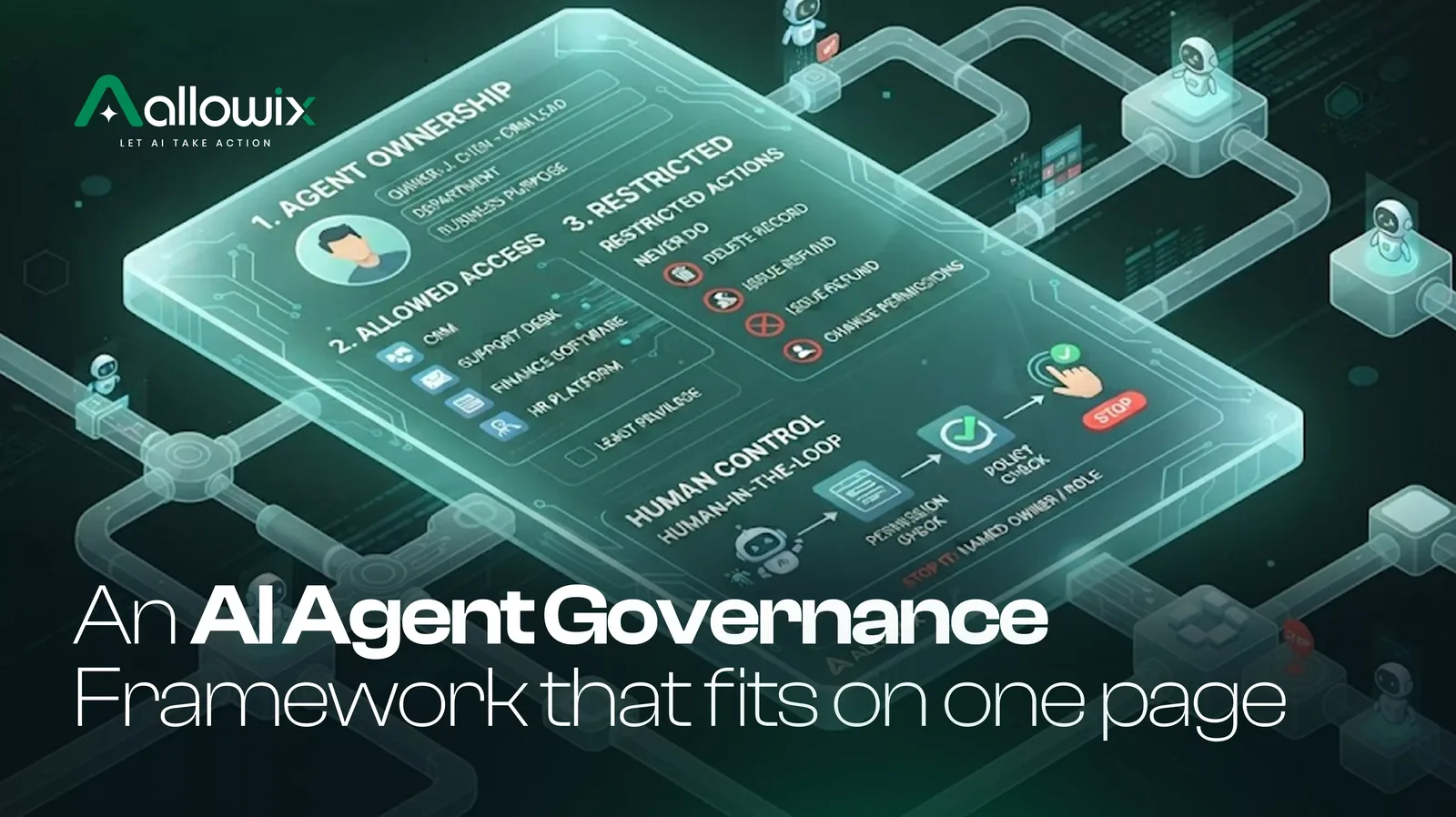
An AI agent governance framework does not need to start with a 60-page policy document. Start with one page.
Before an AI agent gets access to your CRM, help desk, HR system, finance software, or internal tools, you should be able to answer four simple questions:
- Who owns the agent?
- What systems can it access?
- What is it not allowed to do?
- Who can stop it?
If you cannot answer those questions clearly, the agent probably needs more governance before it needs more access.
AI agents are moving beyond answering questions and generating content. They can retrieve information, use tools, trigger workflows, and take actions inside business software. That makes AI governance less about what the model can generate and more about what the agent is permitted to do.
This guide gives you a simple AI agent governance framework you can put on one page, test before connecting sensitive tools, and use as the starting point for controlled AI agent deployment.
Contents
- Key takeaways
- What is an AI agent governance framework?
- The one-page framework
- Put the framework into practice
- Why AI agent security starts with access
- Governance should happen where the action happens
- Your existing business software still matters
- What an AI agent inventory should tell you
- Do you need a separate AI governance platform?
- A practical checklist
- Frequently Asked Questions
- Conclusion
Key takeaways
- An AI governance framework does not have to begin with a complex platform. Start with clear ownership, access, actions, and a way to stop the agent.
- Connecting an AI agent to a business tool gives it a way to act. Treat that access as a permission, not just a technical integration.
- Test human intervention on a harmless action before relying on it for sensitive operations.
- An AI agent inventory is only useful when every agent has a clear owner and someone who can stop it.
- AI agent permissions should be defined before an agent receives access to business systems.
- Human oversight should be practical. A person should be able to intervene without waiting for a meeting or lengthy approval process.
- Allowix sits at the enforcement layer, where permissions, policy, approval, and audit can be checked before an agent performs an action.
What is an AI agent governance framework?
An AI agent governance framework is a set of rules that defines what an AI agent can access, what it can do, who is responsible for it, and how humans can intervene.
That sounds complicated until you reduce it to the questions a business actually needs answered.
Imagine your company creates an AI agent that can work with your customer support system.
Before giving it access, you should know:
- Owner: Who is responsible for this agent?
- Access: Which systems and information can it use?
- Actions: Which actions are allowed, restricted, or prohibited?
- Human control: Who can stop or approve an action?
You can add more controls later.
But these four questions create a useful starting point for AI agent governance.
The goal is not to prevent an AI agent from doing useful work.
The goal is to make its authority clear.
The one-page AI agent governance framework
You can think of the framework as four lines on a page.
1. Who owns the AI agent?
Every AI agent needs a named owner.
Not just a department.
Not “IT.”
Not “the AI team.”
A person or clearly defined role should be accountable for the agent’s behavior, access, and continued use. See how to give an AI agent an identity before you let it act.
If something goes wrong, someone should know immediately: “This is the person responsible for this agent.”
Ownership becomes even more important as businesses move from experimenting with one AI agent to deploying multiple AI agents across different teams and workflows.
An inventory without ownership is simply a list.
2. What can the agent access?
Write down the actual systems.
For example:
- CRM
- Customer support platform
- Project management system
- HR software
- Inventory system
- Internal knowledge base
Avoid vague descriptions such as “company data.” That does not tell you what the agent can actually reach.
Good AI agent access control starts with a specific allow-list.
If a system is not required for the agent’s job, there is a strong reason not to give it access.
This is also where the principle of least privilege becomes useful.
Allowix, for example, calculates effective permission from the intersection of the user’s permissions, the agent’s allowed tools, and organizational policy, with deny-by-default behavior for missing requirements.
3. What is the agent not allowed to do?
This question is often skipped.
Teams spend time defining what their AI agent can do.
They should also define what it must never do.
For example:
- Delete customer records
- Issue refunds
- Change user permissions
- Send external emails
- Modify financial information
- Approve sensitive transactions
You do not need to create a 100-page list of every possible action.
Start with the actions that would create a serious problem if they happened without the right person knowing.
That gives you a practical foundation for AI agent permissions.
4. Who can stop the agent?
This may be the most important question on the page.
If an AI agent is allowed to take action, a human should know how to intervene.
And “send a message in the team channel” is not necessarily a control.
A useful human-in-the-loop process should answer:
- Who can stop it?
- When can they stop it?
- What happens after they stop it?
- Does the agent actually pause?
This is where human-in-the-loop AI becomes more than a phrase in a governance document.
The intervention needs to exist in the workflow.
For example, Allowix supports risk-tiered actions where read-only actions can run automatically, controlled writes can pause for explicit approval, and destructive actions can be blocked.
Put the framework into practice before giving the agent real authority
There is a simple test that many teams can run before connecting an agent to a sensitive workflow.
Don’t start with a refund.
Don’t start with a customer deletion.
Don’t start with an email that goes outside the company.
Start with something harmless.
For example: apply a test tag to a draft record.
Then ask the agent to perform the action.
When the human approval point appears, stop it.
Now ask:
- Did the agent actually pause?
- Could the human identify what was about to happen?
- Was the approval tied to that specific action?
- Did the system record the decision?
- Could the agent continue without approval?
This is a governance test, not a demo.
A successful demo proves that an agent can act.
A successful governance test proves that the business can control that action.
Why AI agent security starts with access
AI agent security is often discussed as a model problem.
But once an agent can interact with business systems, access becomes part of the problem too.
Consider an AI agent connected to a CRM.
The model may be capable of understanding a customer request.
That does not mean it should automatically be able to:
- change customer information
- delete records
- export data
- change account permissions
- send messages externally
The important question becomes: what is this particular agent allowed to do with the access it has?
That is why AI agent security, AI governance, and access control increasingly overlap.
A useful governance model should connect identity, permissions, policy, approvals, and audit evidence rather than treating them as separate checkboxes.
Governance should happen where the action happens
A policy document can say: “Agents must not perform sensitive actions without approval.”
But a document does not stop a tool call.
The control has to exist at the point where the action is attempted.
This is the difference between documenting governance and enforcing governance.
Allowix uses a single governance gate for side-effecting tools. Its architecture checks permission, policy, approval, and audit at the action boundary rather than allowing the AI runtime to execute a side-effecting tool directly.
That creates a simple principle: the closer governance is to the action, the harder it is to bypass.
Your existing business software still matters
You do not need to replace your existing software just because you want to introduce AI agents.
In many businesses, the important systems already exist.
The CRM contains the customer record.
The HR system contains employee information.
The support platform contains tickets.
The ERP contains operational data.
The AI agent should work within those existing boundaries rather than creating a second version of the business.
This is particularly important when introducing AI agents for business.
The question is not simply: “What can this AI agent do?”
It is: “What can this AI agent do inside the systems we already trust?” See how to add AI agents to existing software without a back door.
What an AI agent inventory should tell you
As companies experiment with more AI agents, an inventory becomes useful.
But an inventory should contain more than: Agent name → Team → Status
For every agent, you should be able to identify:
| Governance question | What to record |
|---|---|
| Who owns it? | Named owner |
| Why does it exist? | Business purpose |
| What can it access? | Approved systems/tools |
| What can it do? | Allowed actions |
| What can’t it do? | Restricted actions |
| When does a human intervene? | Approval conditions |
| Who can stop it? | Named person/role |
| What happened? | Audit record |
That turns an agent list into something closer to an AI governance framework.
Without ownership and intervention, the inventory is mostly a directory.
Do you need a separate AI governance platform?
Not necessarily.
You can start with a simple governance document, an agent inventory, and clearly defined approval procedures.
The important thing is that the rules are specific enough to enforce.
A platform becomes useful when the number of agents, tools, permissions, and actions becomes difficult to manage manually.
This distinction matters:
Governance defines the rules.
Enforcement makes those rules happen.
Allowix is designed for the second part. It provides an embeddable governance layer for business software where agent actions can pass through permission, policy, approval, and audit checks.
The governance page still comes first.
A practical AI agent governance checklist
Before connecting an AI agent to a business system, ask:
Ownership
- Does the agent have a named owner?
- Is the business purpose documented?
Access
- Which systems can the agent access?
- Are unnecessary systems excluded?
- Are existing user permissions still authoritative?
Actions
- Which actions can the agent perform?
- Which actions require approval?
- Which actions are blocked completely?
Human oversight
- Who can approve a sensitive action?
- Who can stop the agent?
- Can they intervene without a long escalation process?
Audit
- Can you see what action was attempted?
- Can you see whether it was approved, denied, or blocked?
- Can you identify who approved it?
If several boxes are unanswered, the agent may be ready for another experiment, but not necessarily for broader access.
Frequently Asked Questions
What is an AI agent governance framework?
An AI agent governance framework defines how an organization controls AI agents, including ownership, access, permissions, allowed actions, human oversight, and auditability.
What is the difference between AI governance and AI agent governance?
AI governance is the broader discipline covering how an organization manages AI systems. AI agent governance focuses specifically on agents that can make decisions, use tools, access information, or take actions on behalf of users or organizations.
What are AI agent permissions?
AI agent permissions define which tools, systems, data, and actions an agent is authorized to use. They should be specific enough to prevent an agent from receiving broader access than its job requires.
What is human-in-the-loop AI?
Human-in-the-loop AI means a person remains involved at defined points in an AI workflow, such as reviewing or approving an action before it is executed. The important part is that the intervention is built into the workflow rather than existing only as a policy statement. Read our checklist for human in the loop AI agents.
How should AI agent actions be audited?
An audit trail should make it possible to understand important governance decisions, including the action, risk level, outcome, and approval information. Allowix records governance decisions using references and IDs rather than storing raw record content in the audit trail. See how to add an AI agent audit trail.
Do all AI agents need human approval for every action?
Not necessarily. A practical model can differentiate actions by risk. For example, low-risk read operations may be automated while higher-risk writes require explicit approval and destructive actions are blocked.
Conclusion
An AI agent governance framework does not have to begin with a giant policy document.
Start with one page.
Owner. Access. Restricted actions. Human control.
Then test the control before giving the agent real authority.
Because the important question is no longer only: “Can our AI agent do this?”
It is: “Who gave it permission to do this, and who can stop it?”
That is where useful AI governance begins.
And once the rules are clear, you can move from governance on paper to governance at the point where the AI agent actually takes action.
See governed agents in your own product.
Book a demo and we'll walk your team through the governance model, the two-seam integration, and a use case for your industry.