
AI Agent Security: How to Control What AI Agents Can Access and Do
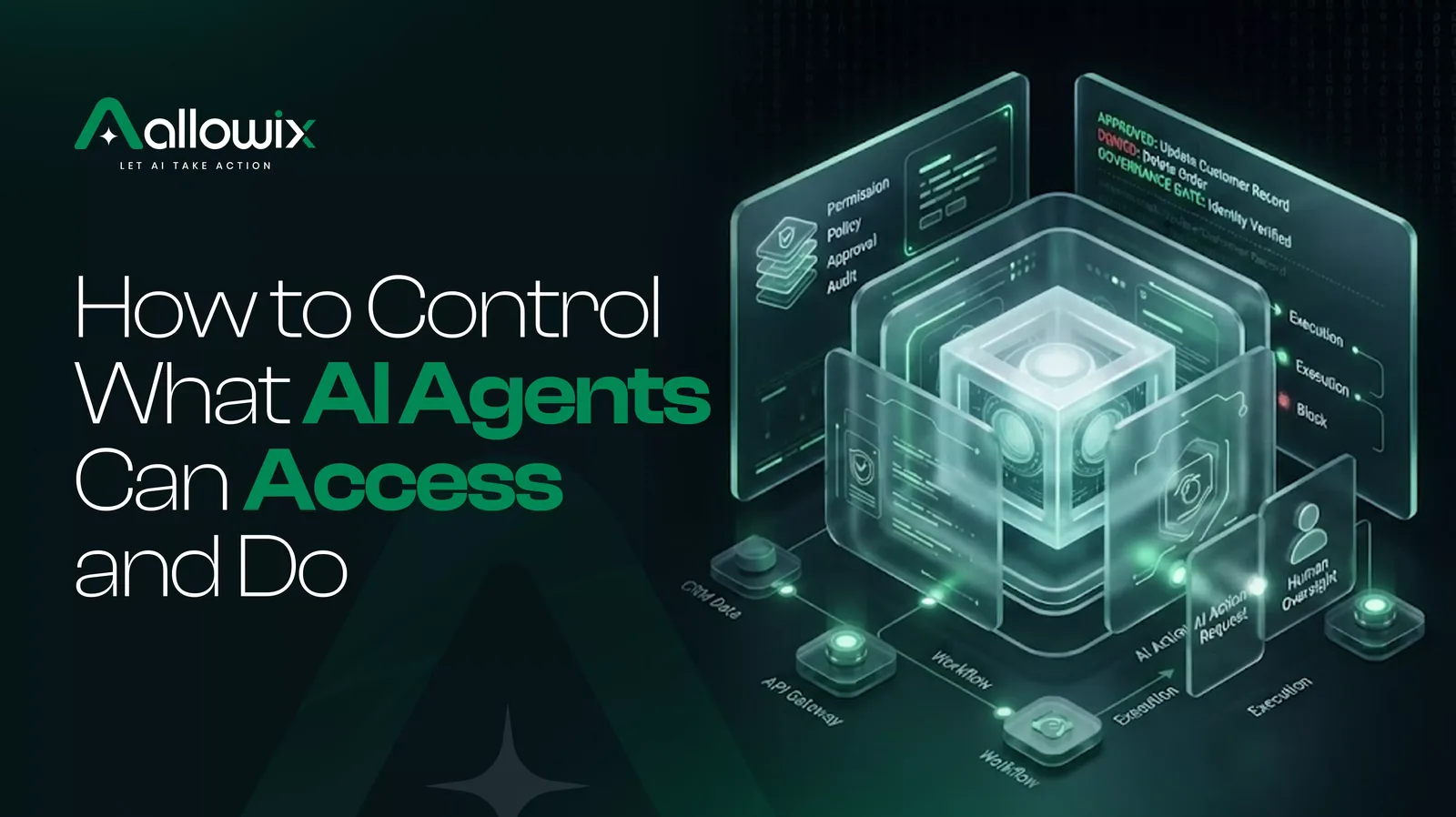
AI agents are moving from answering questions to taking actions. They can read business data, call APIs, update records, trigger workflows, send messages, and work across multiple systems. That is what makes enterprise AI agents useful. It is also what makes AI agent security different from securing a traditional chatbot.
The question is no longer only: what can the model generate?
It is: What can the agent access, what can it do, and who can stop it?
That is where AI agent governance, permissions, human approval, and runtime controls become important.
For teams moving AI agents toward production, security cannot be a policy document added after deployment. It needs to exist at the point where an agent attempts to access data or take an action.
Contents
- Key takeaways
- Why AI agent security is different
- The five questions every AI agent should answer
- AI agent security needs runtime control
- Why putting the control at the tool matters
- What this means for existing business software
- What good AI agent governance looks like
- The goal isn’t less autonomy
- Where Allowix fits
- AI agent security checklist
- Frequently Asked Questions
- Conclusion
Key takeaways
- AI agents need more than model-level safety. They need controls around identity, permissions, tools, and actions.
- AI agent permissions should be limited by the user’s authority, the agent’s allowed capabilities, and organizational policy.
- AI agent governance should happen before an action executes, not only after it appears in a log.
- Human approval is most useful for actions where mistakes have meaningful consequences.
- An AI agent audit trail should record what action was requested, what happened, and who approved it.
- Runtime controls are becoming increasingly important as organizations move agents from pilots into production.
- The goal is not to stop agents from acting. It is to give them enough authority to be useful without giving them unlimited authority.
Why AI agent security is different
A traditional AI assistant may generate an answer.
An AI agent can do something.
It might:
- update a customer record
- create an order
- send an email
- change a status
- retrieve business information
- trigger a workflow
- call an internal API
- coordinate with another agent
That changes the security model.
A bad answer can be corrected.
A completed action may not be reversible.
This is why current enterprise guidance increasingly focuses on authorization, monitoring, identity, least privilege, and runtime enforcement for AI agents. The World Economic Forum’s 2026 guidance, for example, emphasizes authorization and making agent actions auditable and enforceable across deployment.
The same shift is visible in current security guidance from ISACA, which highlights risks including tool misuse, excessive agency, prompt injection, and unauthorized actions.
The five questions every AI agent should answer
Before allowing an agent to operate inside a business system, ask five simple questions.
1. Who is the agent acting for?
An agent should not automatically become a super-user simply because it is powered by an advanced model.
The system should know the identity of the person or process behind the action.
That identity should remain connected to the permissions already established by the host application. See how to give an AI agent an identity before you let it act.
2. What is the agent allowed to access?
An agent may need access to a customer record to answer a question.
That does not mean it needs access to every customer record.
This is where AI agent permissions become important.
A useful model is:
User permissions ∩ Agent permissions ∩ Organization policy
The resulting permission is what the agent can actually use.
If one required permission is missing, the action should fail closed rather than guessing.
Allowix follows this model: effective permission is the intersection of the user’s permissions, the agent’s allowed tools, and organizational policy, with deny-by-default behavior.
3. What can the agent actually do?
Reading information and changing information are not equivalent.
Consider these actions:
| Action | Potential control |
|---|---|
| Read a customer record | Automatic |
| Generate a report | Automatic |
| Draft an email | Automatic |
| Create a record | Controlled |
| Update an account | Approval may be required |
| Approve a financial action | Human approval |
| Delete a record | Blocked or tightly restricted |
The exact policy depends on the business and the consequence of the action.
The important principle is simple:
The more consequential the action, the stronger the control should be.
Allowix uses risk-tiered behavior: read-only actions can run automatically, controlled writes pause for explicit approval, and destructive actions are blocked.
4. When should a human step in?
Human-in-the-loop AI does not mean a person has to approve every sentence an agent generates.
That would remove much of the value of automation.
Instead, human involvement should be connected to the consequence of the action.
A useful pattern is:
AI proposes → system checks → human approves → action executes
For example:
Agent
  ↓
Proposed action
  ↓
Permission check
  ↓
Policy check
  ↓
Human approval
  ↓
Execution
  ↓
Audit record
This keeps the agent useful while creating a clear boundary around higher-risk actions.
Recent enterprise guidance similarly emphasizes that human oversight should increase as agent autonomy and the consequence of its actions increase.
5. Can you explain what happened afterward?
Suppose an AI agent changes a customer account.
A week later someone asks:
Who changed this?
A useful answer should not be: “The AI did it.”
You need to know:
- which agent requested the action
- which user was involved
- what tool was called
- what decision was made
- whether approval was required
- who approved it
- what the outcome was
- when it happened
That is the purpose of an AI agent audit trail.
Logging after the fact is useful for investigation, but logging should not be the only control.
The stronger architecture puts the audit decision on the same governance path as the action.
Allowix records governance decisions using the tool, risk level, outcome, approver, and references while avoiding raw record content in the audit trail.
AI agent security needs runtime control
One of the biggest changes in agentic AI is that security cannot live only in documentation.
Imagine an agent has been told: “Update this customer account.”
The important security question happens immediately before the tool executes:
Is this action allowed right now?
That is the runtime control point.
A governance layer can intercept the proposed action and evaluate:
- Permission — Does this user have authority?
- Policy — Is this type of action allowed?
- Approval — Does this action require a human decision?
- Audit — Can the decision and outcome be recorded?
If the required checks do not pass, the tool should not execute.
This is increasingly becoming a central theme in enterprise AI security. Current security platforms and research are focusing on runtime enforcement because agents can interact with tools, APIs, data, and business workflows in ways traditional chatbot controls were not designed to govern.
Why putting the control at the tool matters
Consider two architectures.
Architecture A: Control after the action
AI
 ↓
Tool
 ↓
Business system
 ↓
Log
 ↓
Security team investigates
The system can tell you what happened.
But the action already happened.
Architecture B: Control before the action
AI
 ↓
Governance gate
 ↓
Permission
 ↓
Policy
 ↓
Approval
 ↓
Tool
 ↓
Business system
 ↓
Audit
Now the system can prevent an unauthorized action before it becomes a business event.
That distinction matters when AI agents are allowed to write to production systems.
What this means for existing business software
AI agent security does not necessarily mean replacing the systems your business already uses.
A CRM can remain the CRM.
An ERP can remain the ERP.
An HR platform can remain the HR platform.
The AI layer can sit between the model and the application’s existing context, permissions, and tools.
This is the approach Allowix takes.
Allowix is an embeddable governed AI layer for business software. The application remains the system of record while the agent layer provides context, planning, approved actions, governance, and audit.
The integration is designed around two seams:
- A web component inside the existing application.
- A five-method backend adapter connecting identity, context, permissions, actions, and notifications.
The platform core does not need to be rewritten. See how to add AI agents to existing software without a back door.
What good AI agent governance looks like
A production-ready approach does not need to mean making every agent slow or requiring approval for everything.
Instead, governance should be proportional to the action.
A practical model looks like this:
Low-risk
Read → answer → report
The agent can proceed automatically when the user and policy allow it.
Medium-risk
Plan → propose → approve → execute
The agent prepares the work, but a person confirms the consequential action.
High-risk
Detect → block
Some actions should not be available to the agent at all.
This approach allows organizations to increase automation without treating autonomy as unlimited access.
The goal isn’t less autonomy
It is bounded autonomy.
The value of an AI agent comes from letting it do useful work.
The security problem begins when “useful” becomes “unrestricted.”
A well-designed system gives an agent:
- the context it needs
- the tools it needs
- the permissions it needs
- the ability to complete useful tasks
- a clear escalation path
- a record of important decisions
And nothing more.
That is the difference between:
“The AI can do anything.”
and:
“The AI can do what we allow it to do.”
Where Allowix fits
Allowix is built around a single governance boundary for agent actions.
Every side-effecting action passes through:
Permission ∩ Policy ∩ Approval ∩ Audit
There is no direct execution path around the governance gate.
The layer can also provide:
- context-aware agents
- no-code agent authoring
- multi-agent orchestration
- interactive output cards
- human approval
- governed voice interactions
- append-only audit records
These capabilities are designed to work inside the business software organizations already use rather than creating another disconnected AI destination.
AI agent security checklist
Before putting an AI agent into production, ask:
- Does the agent have a defined identity?
- Are its permissions limited?
- Are permissions tied to the user’s authority?
- Can the agent call only approved tools?
- Are sensitive actions intercepted before execution?
- Can a human approve consequential actions?
- Are destructive actions blocked where appropriate?
- Is the action recorded?
- Can you identify who approved it?
- Does the control work at runtime rather than only in documentation?
- Can the agent operate inside the software where the work actually happens?
If several answers are “no,” the problem may not be the AI model.
It may be the layer around the model.
Frequently Asked Questions
Is AI agent security the same as traditional cybersecurity?
No. Traditional cybersecurity still matters, but AI agents introduce additional concerns because they can reason, use tools, access data, and take actions. Current guidance increasingly treats identity, permissions, tool access, runtime enforcement, and agent behavior as distinct parts of the security problem.
Should every AI agent action require human approval?
No. Requiring approval for every low-risk read would create unnecessary friction. A better approach is to match oversight to the consequence of the action.
What are AI agent permissions?
They are the boundaries defining what an agent can access or do. For example, an agent might be allowed to read an order but not approve a refund.
What is an AI agent audit trail?
It is a record of important agent decisions and actions, including relevant actors, tools, outcomes, and approvals. See how to add an AI agent audit trail without rebuilding your product.
Can AI agents work inside existing software?
Yes. An agent can be embedded into an existing application rather than forcing users into a separate AI portal. Allowix is designed specifically around this model.
Is Allowix an AI model?
No. Allowix is an embeddable governed AI layer. Its current product uses OpenAI models while adding the context, permission, policy, approval, action, and audit layer around agent execution.
Conclusion
AI agents are becoming more capable of doing real work.
That changes the question businesses need to ask.
Not: Can the AI do it?
But: Can we control what it is allowed to do?
AI agent security starts where the agent touches the real world: data, tools, APIs, records, and workflows.
The goal is not to keep agents away from business systems.
It is to give them the right access, the right boundaries, and a clear record of what happens.
That is the role of a governed AI layer.
Allowix brings governed AI agents into the business software you already run.
Sources: World Economic Forum, AI Agents in Action accessed 2026-09-21; ISACA, Five Key Considerations for Securing Agentic AI accessed 2026-09-21.
See governed agents in your own product.
Book a demo and we'll walk your team through the governance model, the two-seam integration, and a use case for your industry.