
Human in the Loop AI Agents: An AI Agent Governance Checklist Before Production
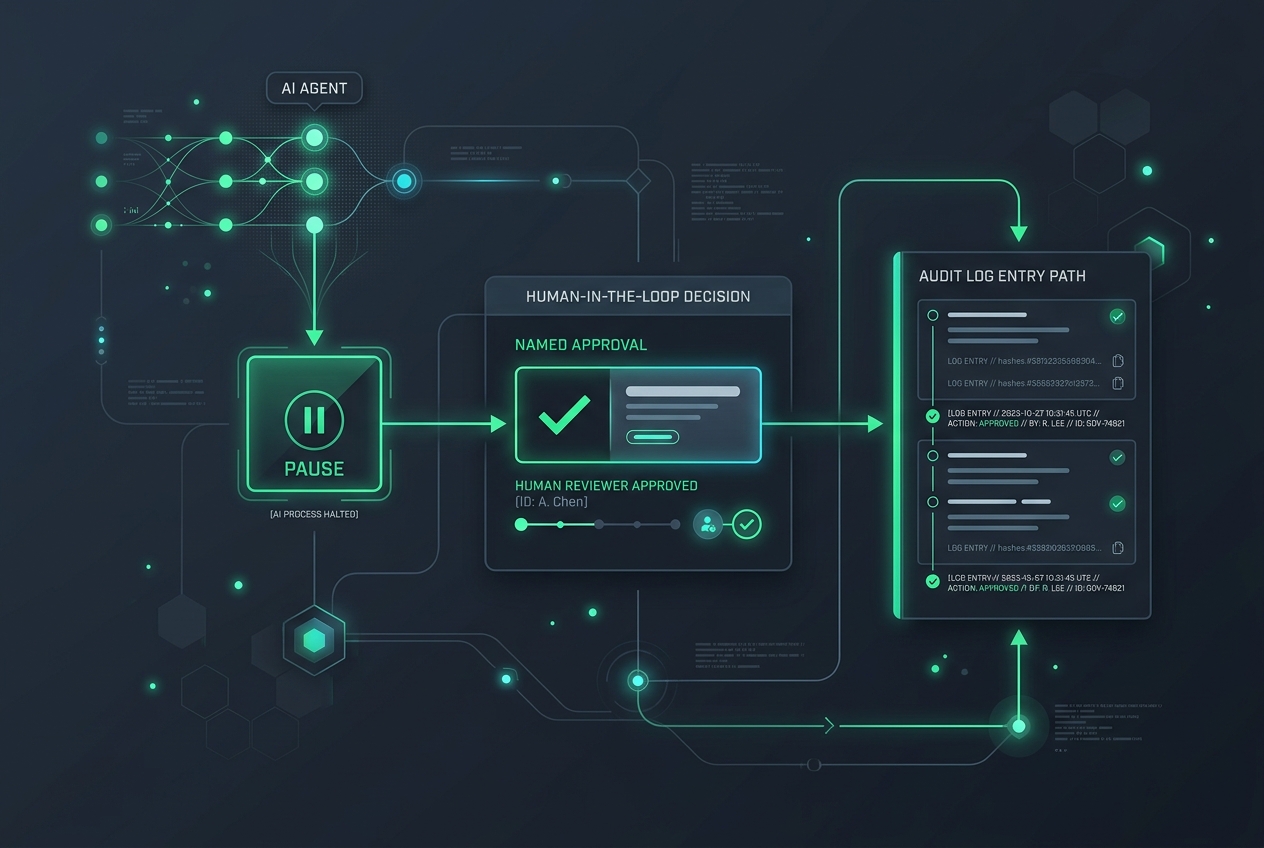
Human in the loop AI agents is not a slide. It is a production rule: the agent waits, a named person signs, and the receipt stays. IBM’s definition of human in the loop is still the useful one: a person participates in the operation or decision of an automated system. For AI agents at work, that person has to be able to stop a write, not only read a summary after the fact.
This article is for product, platform, and ops leads who have a demo that can send, file, or change a record. You will get a standalone definition, a four-check AI agent governance table, a five-step production checklist, and the questions auditors actually ask. Allowix is the product name (published by Solvefy). We do not call the product “Agentic AI.” We do not invent customers, prices, or scores.
Contents
Key takeaways
- HITL AI for agents means interrupt, named yes, then resume. A channel ping is a notification, not a signature.
- OpenAI’s Agents SDK documents human-in-the-loop as interrupting a run so a person can approve or reject before the next tool call. That is the right shape.
- AI agent governance needs four checks on the same action: permission, policy, approval, audit. If any layer fails, the action does not run.
- Reserve blocking approval for writes that are hard to undo. Low-risk reads can stay fast. Blanket pauses create rubber-stamping.
- There is no production “demo mode” that skips the log. Optional pauses become missing receipts.
What human in the loop AI agents means
Human in the loop means a person can stop, change, or confirm an action before it becomes real. Chatbots answer. Agents act. Acting is why the pause exists.
OpenAI’s Agents SDK describes the pattern as interrupting a run so a person can approve or reject before the next tool call. Engineering write-ups in 2026 (LangGraph interrupts, Agent SDK needs_approval) say the same operational sentence: persist state, wait, resume with a decision.
The kitchen-table version is shorter: the work waits. A named person signs. The receipt stays.
If your product says “HITL” and the wait is optional in production, you do not have human in the loop AI agents. You have a slogan.
Oversight guides (Sweet Security and similar) add the evidence test: you must be able to show who reviewed what, what they saw, and whether the action was blocked until they signed. EU AI Act Article 14 language on human oversight for high-risk systems points the same direction. We are not claiming a legal opinion in this post. We are saying the operational bar matches what buyers now search: AI agent governance you can show, not a policy PDF.
Why Slack is not AI agent approval
Teams confuse notification with AI agent approval.
A channel named AI-help gets a message. Three people see it. Nobody owns it. The agent continues because nobody typed no. That is hope with emoji.
DevRev’s 2026 AI governance writing keeps coming back to the same operational idea: policy has to sit in the path of work, not in a PDF. Permission Protocol-style compliance notes say the same in a drier voice.
If the action is hard to undo, a person must say yes on that action, as themselves, on that record. When AI agents at work go wrong after a group ping, you will not know who signed. You will know who was in the channel.
The four-check governance gate
Allowix’s rule is a single gate. An action does not run unless all four pass.
| Check | Question | Failure mode if skipped |
|---|---|---|
| Permission | Does this person’s role allow this on this record? | Shared admin account; agent sees more than the user |
| Policy | Does this company allow this kind of tool here? | A “just this once” write in a forbidden system |
| Approval | Does this class of action need a human yes? | Fast intern with a badge, no pause |
| Audit | Are inputs, outputs, and actor written down? | Tuesday becomes an argument with no receipt |
If any layer fails, the action does not run. There is no production demo flag that skips the log.
Card types: the product model has exactly 12 interaction cards. Predictable screens keep permission mapping boring. Boring is good when an agent would otherwise invent a thirteenth way to skip the wait.
Models: Allowix is OpenAI only in current product scope. Do not read other brand names into this post.
Five steps before you turn the volume up
1. List actions that are hard to undo
Money-adjacent instructions. Status a customer can see. Messages that leave the building. Not “rewrite this paragraph in a friendlier tone” unless that paragraph is about to send.
2. Map each class to blocking vs monitor
Blocking human in the loop for irreversible writes. Monitoring or logging for low-risk reads. If you pause everything, people click through. Sweet Security and HITL architecture notes both warn about rubber-stamp approval.
3. Name the signer (a person, not a channel)
If this is wrong at 9 p.m., whose phone rings. If the room cannot answer, you do not have AI agent governance. You have a hero. Heroes go on holiday.
4. Require identity on the yes
The agent uses that person’s rights, not a shared god account. The log stores who signed, what they saw, and the decision.
5. Ban production bypass
Someone will ask to skip the wait because a demo is in ten minutes. If the product allows it in production, you taught the team that human in the loop AI agents is optional.
Write the pause like a fire drill. Who can stop this class of action. Who reads the log. Who calls the customer.
What we will not claim
- Specific ROI percentages (which require validation for each customer scenario)
- Pricing details (as confirmed pricing is not yet published)
- Invented certificates or unnamed “Fortune 500” wins
We will not tell you every action needs a human tap. We will tell you AI agent approval has to be a first-class step for writes that matter.
Frequently Asked Questions
Is a Slack ping enough for human in the loop AI agents?
No. A ping is a notification. Human in the loop AI agents need a named yes on the action, plus a log.
What is AI agent approval in one sentence?
A person signs this action, as themselves, before it runs.
Can we skip the pause for a demo?
Not in production. A demo that skips the log trains the team to ship the hole later.
Are chatbots the same as agents here?
No. Chat answers. Agents act. Acting is why the pause exists.
Do we need twelve different approval screens?
No. Allowix uses 12 card types so the interaction stays predictable. Approval is a check in the gate, not a new product for every mood.
Is this the same as human-on-the-loop?
Human-on-the-loop is watching while the system runs. HITL AI here is a block before a risky write. Match the pattern to the risk. Do not use a monitoring dashboard as a substitute for a signed yes on an irreversible action.
Conclusion
Human in the loop AI agents is a pause, a named yes, and a log. AI agent governance is those four checks on the same gate.
If you are comparing tools, ask them to show the wait. Ask whose name lands on the receipt. If they cannot, you will own the 9 p.m. call anyway. Write the pause this week, even if the agent is still a pilot.
Sources: OpenAI Agents SDK, Human in the loop accessed 2026-08-31; IBM, What is human in the loop accessed 2026-08-31; DevRev, AI governance accessed 2026-08-31; Sweet Security, AI agent human oversight accessed 2026-08-31; Permission Protocol, Compliance accessed 2026-08-31.
See governed agents in your own product.
Book a demo and we'll walk your team through the governance model, the two-seam integration, and a use case for your industry.