
How to Add an AI Agent Audit Trail Without Rebuilding Your Product
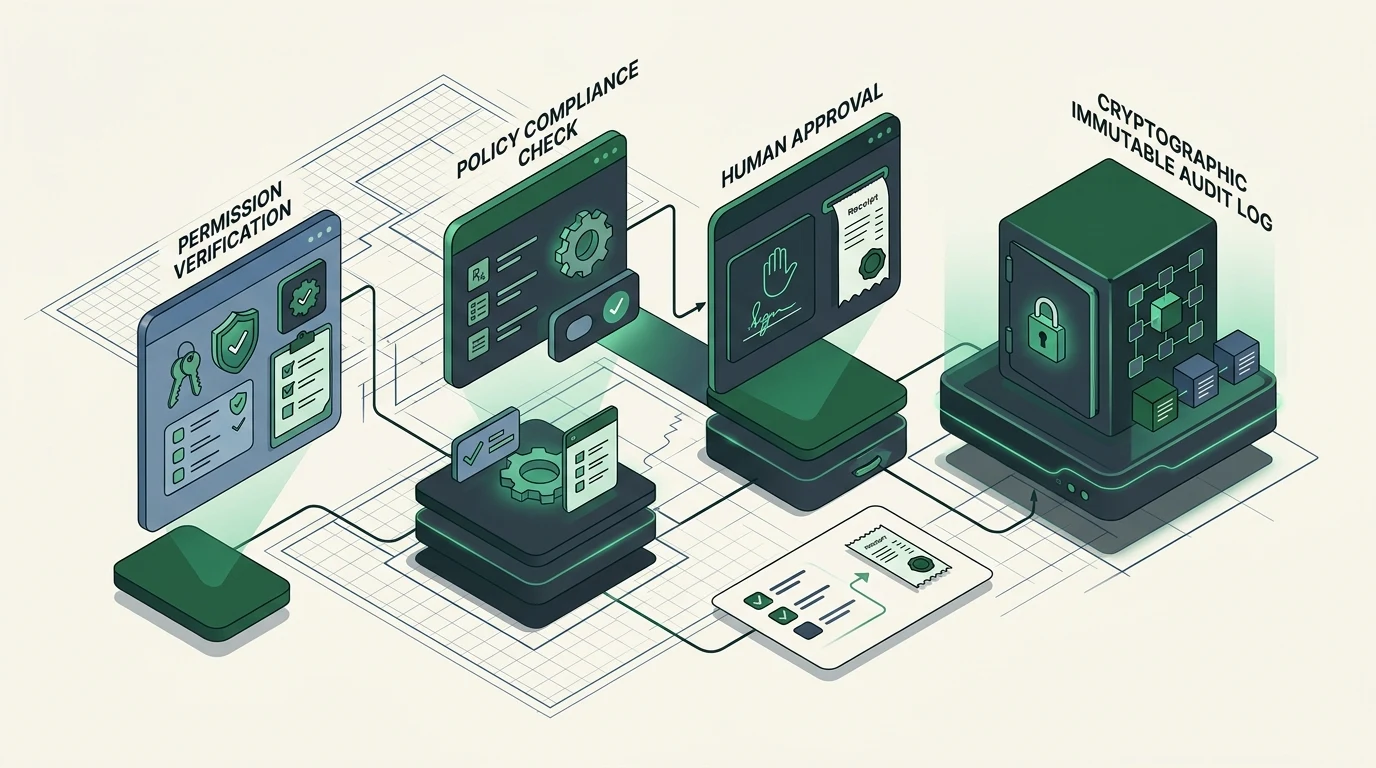
An AI agent audit trail is not a PDF of principles. It is a receipt: who the agent was, what it saw, what it tried to do, who signed, and whether the write ran. Chatbots answer. Agents act. Acting is why the log exists.
This article is for product and platform leads who have a demo that can send, file, or change a record. You will get a standalone definition, a four-check table, a five-step embed path that does not require ripping your product into a new agent operating system, and the questions auditors actually ask. Allowix is the product name (published by Solvefy). We do not call the product “Agentic AI.” We do not invent customers, prices, or scores.
Contents
Key takeaways
- An AI agent audit trail stores actor, inputs, outputs, decision, and time. A Slack ping is not a receipt.
- Embed AI agents means govern in place: intercept the tool call in the product you already run.
- AI agent governance needs four checks on the same action: permission, policy, approval, audit.
- 2026 “govern in place” writing (Microsoft Agent Hooks, similar control planes) rhymes with that shape: intercept, verdict, record.
- There is no production demo flag that skips the log.
What an AI agent audit trail is
An AI agent audit trail is the evidence that an action was allowed or blocked. You must be able to show who reviewed what, what they saw, and whether the action waited.
IBM’s human-in-the-loop idea still helps: a person participates in the operation. For human in the loop AI agents, that person has to be able to stop a write. OpenAI’s Agents SDK describes interrupting a run so a person can approve or reject before the next tool call. The kitchen-table version: the work waits. A named person signs. The receipt stays.
If your product says “we log everything” and the log is a chat transcript with no identity on the yes, you do not have an audit trail. You have a diary.
Why a rebuild is the wrong first move
Teams hear agents and shop for a new runtime. Sometimes you need one. Often you need a gate on the tools you already have.
Microsoft’s 2026 Agent Hooks pitch is useful even if you never adopt that spec: write controls once, intercept the agent loop, keep an interception record. KLA-style “govern in place” language is the same operational sentence. You wrap the call. You do not throw away the product.
Embed AI agents without a rebuild means: same screens people already use, same permissions, a gate in front of irreversible tools. A thirteenth portal named Agent HQ becomes unused software with a cooler logo.
The four-check gate
Allowix’s rule is a single gate. An action does not run unless all four pass.
| Check | Question | Failure if skipped |
|---|---|---|
| Permission | Does this person’s role allow this on this record? | Shared admin; agent sees more than the user |
| Policy | Does this company allow this tool here? | A “just this once” write in a forbidden system |
| Approval | Does this class of action need a human yes? | Fast intern, no pause |
| Audit | Are inputs, outputs, and actor written down? | Tuesday becomes an argument with no receipt |
If any layer fails, the action does not run.
Card types: the product model has exactly 12 interaction cards. Predictable screens keep permission mapping boring.
Models: Allowix is OpenAI only in current product scope. Do not read other brand names into this post.
Five steps to embed governance
1. List tools that are hard to undo
Money-adjacent instructions. Status a customer can see. Messages that leave the building.
2. Intercept before the tool runs
Persist state. Wait. Resume with a decision. That is the Agents SDK shape. It is also the only shape that produces an AI agent audit trail.
3. Bind the yes to a person, not a channel
If this is wrong at 9 p.m., whose phone rings.
4. Store the receipt with the action
Who signed, what they saw, allow or block, timestamp. AI agent permissions follow that person’s rights, not a god account.
5. Ban production bypass
Someone will ask to skip the wait because a demo is in ten minutes. If the product allows it in production, you taught the team that AI agent governance is optional.
What we will not claim
- Specific ROI percentages (which require validation for each customer scenario)
- Pricing details (as confirmed pricing is not yet published)
- Invented certificates or unnamed “Fortune 500” wins
We will not tell you every action needs a human tap. We will tell you the log has to exist for writes that matter.
Frequently Asked Questions
Is a chat log an AI agent audit trail?
No. A chat log is content. An audit trail is identity, decision, and whether the tool ran.
Can we embed this without rewriting the app?
That is the point of govern-in-place. Intercept the tool. Keep the product.
Is this the same as last week’s HITL post?
Related. Last week: pause, named yes, log (see our guide on human in the loop AI agents). This week: how the log exists without a rebuild.
Do we need twelve approval screens?
No. Allowix uses 12 card types so the interaction stays predictable. Approval is a check in the gate.
Can we skip the trail in a pilot?
Not if the pilot can write. A pilot that skips the log trains the hole.
Conclusion
An AI agent audit trail is a pause you can prove. Embed AI agents by putting the four checks on the tools you already have, not by buying a second product people will not open.
If you are comparing vendors, ask them to show the receipt. Ask whose name lands on it. If they cannot, you will own the 9 p.m. call anyway.
Sources: Microsoft, Agent Hooks accessed 2026-09-07; OpenAI Agents SDK, Human in the loop accessed 2026-09-07; IBM, Human in the loop accessed 2026-09-07.
See governed agents in your own product.
Book a demo and we'll walk your team through the governance model, the two-seam integration, and a use case for your industry.